De cuatro imágenes de referencia a un corto animado.
Un storyboard, una hoja de personajes, una tabla de estilos y unas localizaciones. Con eso Invideo AI monta el corto entero , planos, cámara, luz y continuidad , a partir de una idea sobre un ramen.
Cuatro documentos, un corto de ramen.
El truco no es pedirle a Invideo “hazme un vídeo”. Es entrar como quien entra a una reunión de producción: con personajes definidos, estilo cerrado, localizaciones elegidas y un storyboard por plano. Cuando el agente recibe esos cuatro documentos, deja de improvisar y empieza a dirigir contigo.
Invideo AI funciona como un director asistente: tú aportas la biblia visual del proyecto, él se encarga del trabajo repetitivo de encuadre, iluminación, continuidad entre planos y renderizado. La calidad del corto final depende del 90% de esos documentos previos y del 10% de saber pedirle el plano correcto.
En este desglose ves los cuatro archivos reales que se subieron al agente para producir el corto del ramen, en el orden en el que se le entregaron. Cada bloque incluye el prompt que se le pasó, para que puedas replicar el proceso paso a paso con tu propia historia.
Personajes, estilo, localizaciones y storyboard. Ese es todo el input que necesita el agente.
Del close-up del cuchillo al wide del cliente saboreando. Cada plano tiene una intención emocional.
Lo que antes eran semanas de preproducción se resuelve en una sesión de trabajo.
Define quién sale en el corto.
Antes de renderizar nada, se le da al agente una character sheet con los tres protagonistas ,Chef, Aprendiz y Cliente, en pose frontal y de perfil. Así mantiene el mismo rostro, la misma ropa y las mismas proporciones plano a plano.
La vista frontal + perfil no es un capricho estético: es lo que le permite al modelo reconstruir el personaje desde cualquier ángulo sin inventárselo. Sin esta hoja, cada plano genera una cara ligeramente distinta y el corto se cae por continuidad.
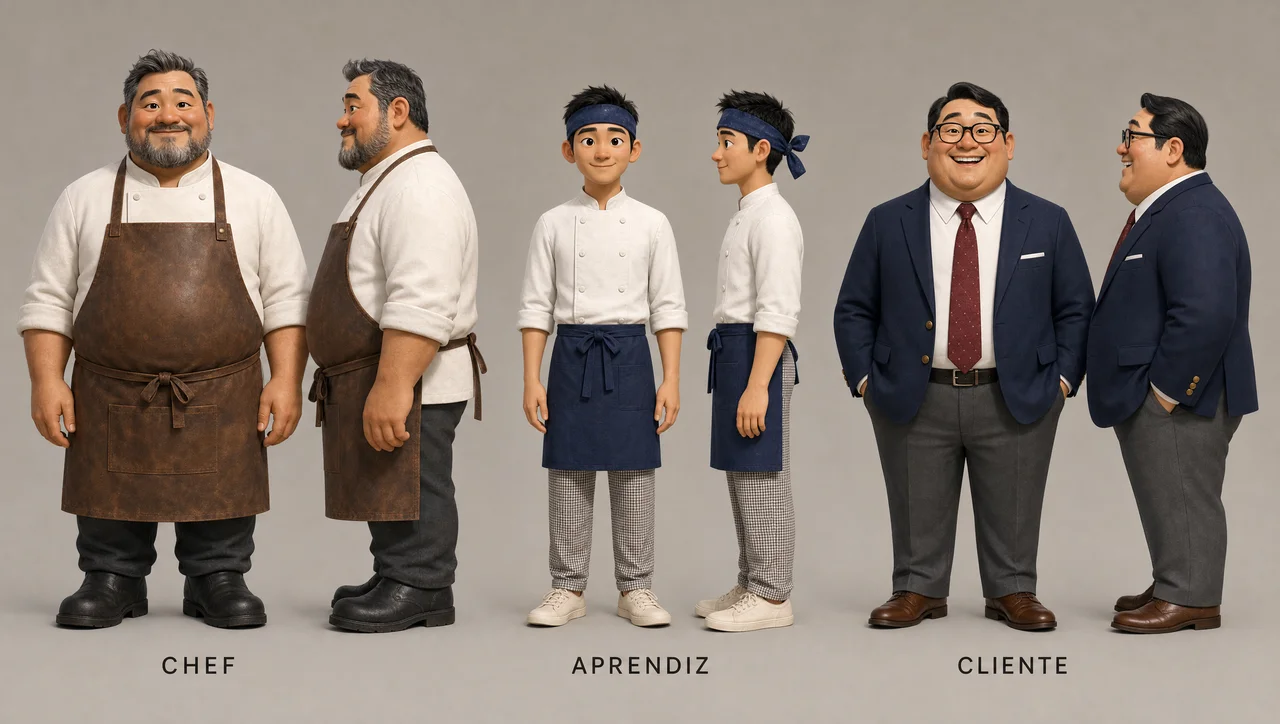
- Frontal + perfil de cada personaje sobre fondo neutro gris.
- Nombre y rol debajo (Chef, Aprendiz, Cliente) , el agente los referencia por nombre luego.
- Misma iluminación y escala para los tres , evita que uno parezca más “detallado” que otro.
- Ropa definitiva ya puesta: delantal marrón, delantal azul, traje. Cambiarla después rompe la continuidad.
Ver prompt completo
A clean 3D animated feature-film CHARACTER TURNAROUND SHEET on a plain warm grey studio background. High-end stylized animation look, appealing stylized characters, soft rounded features, subsurface skin shading, physically-based materials, soft studio lighting.

Three characters, each shown as a FRONT view and a SIDE profile view standing full-body, with a printed label centered beneath each character group.

LEFT group labeled "CHEF": a heavyset warm veteran ramen chef, mid-40s, short salt-and-pepper hair, neat greying beard, kind face, white chef jacket with rolled sleeves, a worn brown leather apron, dark grey trousers, black boots.

CENTER group labeled "APRENDIZ": a young JAPANESE apprentice chef, early 20s, with short neat black hair and an INDIGO TENUGUI HEADBAND tied around his forehead, a friendly rounded face, warm dark eyes, a SMALL STRAIGHT NOSE (not long or pointed), a gentle natural smile, average lean upright build, clean white chef jacket, an INDIGO apron, light checked trousers, pale sneakers.

RIGHT group labeled "CLIENTE": a cheerful heavyset middle-aged Japanese businessman, black hair, dark-rimmed glasses, warm smile, navy blazer, white shirt, dark red tie, grey trousers, brown shoes.

Evenly spaced, consistent scale showing the height differences, clean neutral background, professional character design lineup. Labels in clean simple capital letters. 16:9.
Cierra el look antes de animar.
Antes del render final, se prueba al Aprendiz en 16 direcciones visuales distintas ,3D Pixar, anime, acuarela, pixel-art, LEGO, ganchillo, boceto a lápiz, para ver cuál aguanta un corto entero de cocina. El elegido: 3D estilo Pixar.
La prueba se hace siempre sobre el mismo personaje y el mismo encuadre, no sobre planos distintos. Así comparas peras con peras: solo cambia el estilo, y el ganador se ve enseguida. Elegir un estilo antes de tener las 16 opciones delante es la forma más rápida de quedarte con la primera idea, no con la mejor.
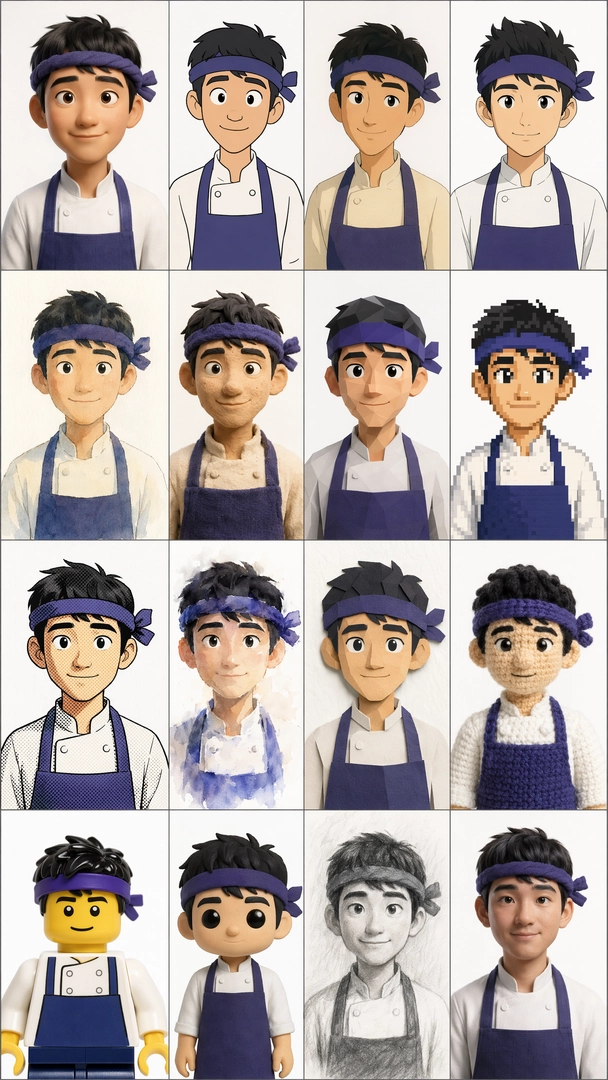
- Mismo encuadre en las 16 pruebas , normalmente busto en primer plano.
- Estilos con rango de riesgo: mezcla lo seguro (3D, anime) con lo experimental (ganchillo, LEGO, lápiz).
- Piensa en escenas difíciles: si el corto tiene vapor, brillos y comida, descarta estilos planos sin textura.
- Elige uno y quémalo: el estilo elegido condiciona personajes, luz y transiciones. Cambiar a mitad rompe todo.
Ver prompt completo
Create ONE single still image: a 4x4 grid (exactly 16 equal panels) showing the SAME character rendered in 16 DIFFERENT animation/art styles. Aspect ratio 1:1 (square). SINGLE IMAGE ONLY, no video.

CHARACTER (identical in all 16 panels): the "blue apprentice", the young East Asian male ramen cook from the reference (the TOP-LEFT character of the reference sheet): friendly young man, black hair with an indigo/blue headband, white chef's jacket, blue/indigo apron. Same character, same head-and-shoulders front-facing portrait framing in every panel; ONLY the rendering style changes. Keep him clearly recognizable as the same person across all styles.

Render the SAME character in these 16 distinct styles, one per panel:
1. Pixar-style 3D animation
2. Flat 2D TV cartoon (bold outlines, simple shapes)
3. Classic Disney hand-drawn 2D animation
4. Japanese anime, cel-shaded
5. Studio Ghibli soft watercolor style
6. Claymation / stop-motion clay figure
7. Low-poly 3D
8. Pixel-art / retro 8-bit
9. Comic-book ink with halftone shading
10. Loose watercolor painting
11. Papercraft / layered paper cutout
12. Knitted amigurumi / crochet doll
13. LEGO-style brick minifigure
14. Vinyl designer toy / Funko-style
15. Charcoal / pencil sketch
16. Photoreal realistic CGI

LAYOUT: clean 4x4 grid, 16 equal cells, thin neutral gutters, a simple plain light background behind the character in each cell so the STYLE is what stands out.

CONSTRAINTS: exactly 16 panels; NO text, labels, numbers, captions or logos anywhere; the same blue-apprentice character in every panel; each panel a clearly different, recognizable animation style.
Elige el escenario del corto.
Con el estilo cerrado, se le pide al agente seis versiones del mismo ramen-ya ,cocina, barra, comedor, entrada con noren, salón privado, para elegir dónde se cuenta cada plano. Todas comparten luz cálida, madera y farolillos: continuidad visual garantizada.
El objetivo no es tener seis restaurantes bonitos, es tener seis ángulos del mismo restaurante. Cuando cortas de la cocina a la barra, el espectador debe sentir que está en el mismo sitio, solo que ha girado la cabeza. Esa sensación se consigue fijando paleta, materiales y fuente de luz antes de generar.
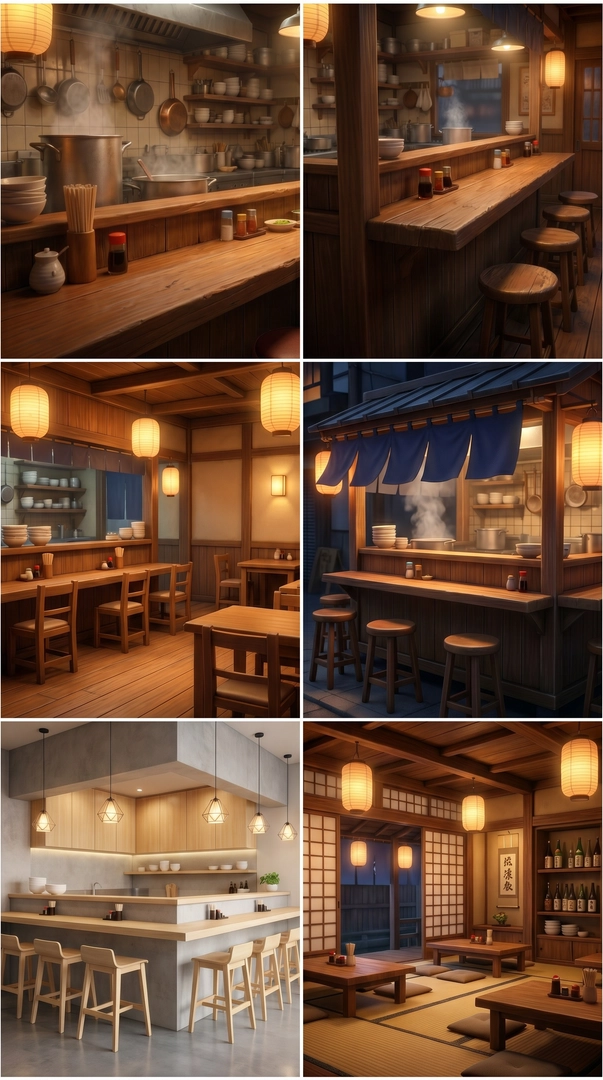
- Paleta común: madera cálida, cerámica blanca, farolillos naranjas, azul marino de acento.
- Fuente de luz coherente: siempre lámparas de papel y luz cálida , sin luz fría de neón.
- Ángulos complementarios: cocina, barra frontal, comedor lateral, entrada exterior, mesa baja, detalle de estantería.
- Sin gente en las localizaciones , los personajes se añaden después para tener control.
Ver prompt completo
Create ONE single still image: a 9:16 vertical grid of 6 restaurant-interior variations. Exactly 6 panels in a 2-column by 3-row layout, equal cells, separated by thin clean white gutters.

Subject: cozy Japanese ramen-shop INTERIORS, completely empty spaces. Use Image 1 and Image 2 as references for the location in Panel 1.

PANEL 1 (top-left): matches the established ramen-ya from the references. Warm honey-wood counter, hanging paper lanterns, open kitchen behind the counter with big broth pots, copper pans, stacked bowls, cozy traditional Japanese decor, warm golden lighting.
PANEL 2 (top-right): a tiny narrow counter bar with stools.
PANEL 3 (middle-left): a larger wooden dining room with tables.
PANEL 4 (middle-right): a street-facing ramen stall (yatai) with a noren curtain.
PANEL 5 (bottom-left): a modern minimalist ramen bar in concrete and blond wood.
PANEL 6 (bottom-right): a rustic traditional izakaya-style room with tatami and lanterns.

Style: Pixar-style 3D animation, warm cinematic render, soft lighting, cohesive look across all six panels.

Constraints: ABSOLUTELY NO people, no characters, no chefs, no customers, no hands, no figures of any kind. NO readable text, signage words, labels, captions or logos. All surfaces that could carry text should be plain or have abstract shapes.
Dibuja el corto antes de renderizarlo.
El último documento es el más importante: un storyboard de 12 planos con el tipo de plano (close-up, over-shoulder, wide), la acción y la intención emocional. Aquí es donde se decide el ritmo , de la cocina íntima a la reacción del cliente , y donde se cierra la paleta de color del corto.
El storyboard hace tres cosas a la vez: define el montaje antes de renderizar (barato de cambiar), obliga a pensar en cámara (no todo son planos medios) y fija la paleta de color , en este caso fuego, caldo, vapor, cocina y hierbas , que se reutiliza en todos los prompts posteriores.
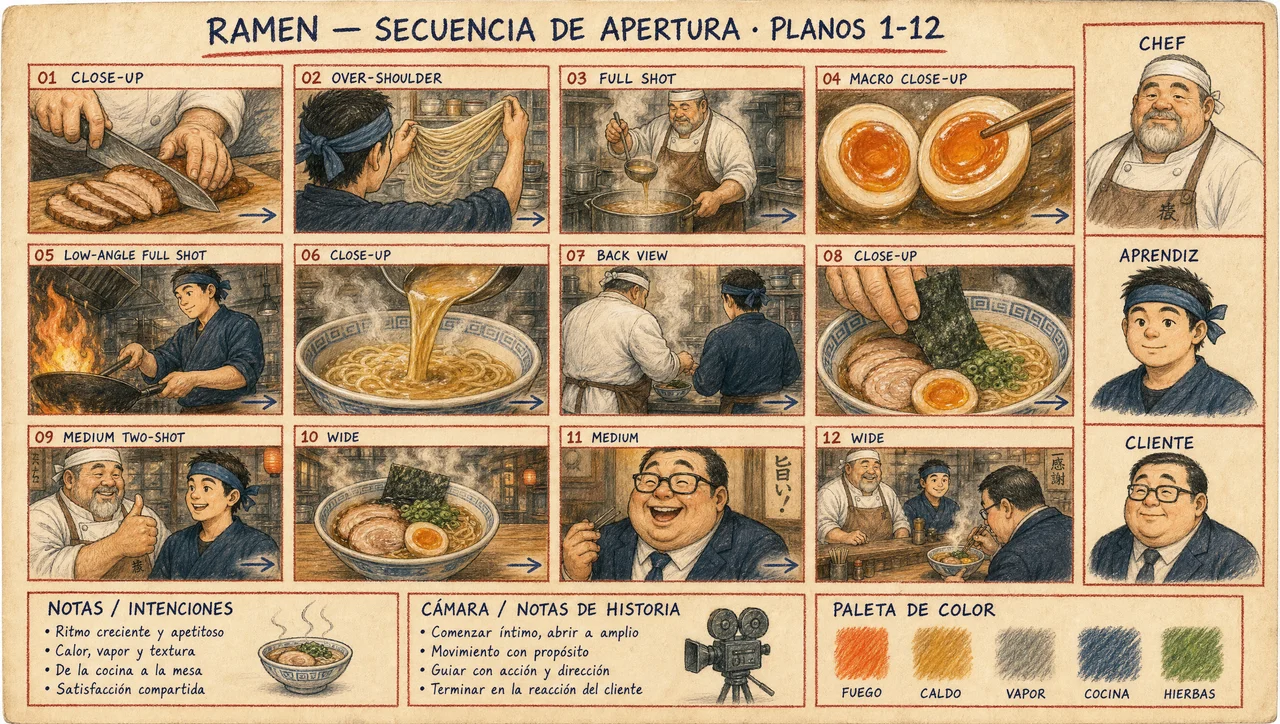
- Numeración y tipo de plano en cada viñeta (01 close-up, 02 over-shoulder…).
- Arco emocional: empieza íntimo (cuchillo, manos), abre a wide (cliente disfrutando).
- Paleta de color nombrada: fuego · caldo · vapor · cocina · hierbas , se cita literal en los prompts.
- Notas de intención: “ritmo creciente y apetitoso”, “de la cocina a la mesa”, “satisfacción compartida”.
Ver prompt completo
Hand-drawn animation STORYBOARD SHEET, 16:9, colored-pencil and marker sketch style: loose confident linework, soft colored shading, visible pencil texture, warm cream paper background.

Match the medium, page layout and hand-drawn energy of Image 1 (a storyboard reference sheet): a title bar across the top, a grid of numbered sketch panels with thin red frames and small blue action arrows, a character sidebar on the right, and a bottom info strip. Do NOT copy the subjects, scenes, characters, or any text from Image 1: take only its drawing style and page layout.

Characters must match Image 2 (the approved character sheet), kept recognizable in loose sketch form: CHEF (heavyset older man, salt-and-pepper hair, grey stubble beard, white chef's jacket, olive-brown waxed apron); APRENDIZ (lean tall young man, curly brown hair, freckles, white double-breasted chef's jacket, white apron); CLIENTE (stocky Japanese businessman, rectangular glasses, navy suit, red tie).

Title bar across the top, EXACT TEXT: "RAMEN, SECUENCIA DE APERTURA · PLANOS 1-12". Below, 12 numbered sketch panels in a 4-column by 3-row grid, each a warm Japanese ramen-shop kitchen scene:
01 CLOSE-UP: the CHEF's hands slicing chashu pork on a wooden board, small motion lines.
02 OVER-SHOULDER: over the APRENDIZ's shoulder, his hands stretching fresh noodles, nervous energy.
03 FULL SHOT: the CHEF standing, ladling steaming broth from a big pot, steam rising.
04 MACRO CLOSE-UP: a soft-boiled egg halved, glossy runny yolk, held between chopsticks.
05 LOW-ANGLE FULL SHOT: the APRENDIZ flambeing a wok, big flames leaping up, wide-eyed startled face.
06 CLOSE-UP: broth pouring from a small saucepan into a ramen bowl over noodles.
07 BACK VIEW: both cooks seen from behind, leaning over the counter assembling the bowl together.
08 CLOSE-UP: the CHEF's hand placing the final garnish, scallions and nori.
09 MEDIUM TWO-SHOT: the CHEF gives the APRENDIZ an approving nod; the APRENDIZ looks relieved.
10 WIDE: the finished ramen bowl sliding across the counter toward the CLIENTE.
11 MEDIUM: the CLIENTE's face lighting up with delight, glasses fogged by the steam.
12 WIDE: the CLIENTE taking the first slurp while both cooks watch, satisfied.

Label each panel with its number 01-12 and a short shot-type note in small hand-lettered caps. Small blue arrows indicate motion in each panel.

Right sidebar with header EXACT TEXT: "PERSONAJES", showing three small sketched busts labeled EXACT TEXT: "CHEF", "APRENDIZ", "CLIENTE".

Bottom strip: a color-palette row of five swatches labeled EXACT TEXT: "FUEGO", "CALDO", "VAPOR", "COCINA", "HIERBAS". Warm palette: fire orange, broth amber, steam grey, slate kitchen blue-grey, herb green.

Keep all other markings as loose illustrative hand-lettering. Keep labels short and legible, no duplicate text, no garbled lettering.
Lo que se aprende cuando ya has hecho el corto.
El orden importa
Personajes → estilo → localizaciones → storyboard. Cambiarlo mete al agente en bucle: si eliges estilo antes de personajes, la character sheet no aguanta el look.
El estilo condiciona el resto
Un estilo Pixar te da vapor y brillos; un pixel-art no. Prueba las escenas más difíciles del corto en la fase de estilo, no en el render final.
Menos localizaciones, mejor
Con 4-6 vistas del mismo sitio se cuenta un corto entero. Cambiar de restaurante a mitad del corto rompe la ilusión de mundo.
Nombra tu paleta
Bautiza los colores (fuego, caldo, vapor…). El agente los reutiliza literales y el corto queda coherente sin tener que pegar hex codes.
Storyboard antes que render
Un plano mal encuadrado se resuelve en 30 segundos sobre papel. Sobre el render final cuesta minutos de cómputo y créditos.
Guarda los prompts
Cada bloque del corto sale de un prompt reutilizable. Trátalos como plantillas: los del ramen sirven para paella, para café, para cualquier historia de cocina.
El agente no hace el corto por ti , hace el corto contigo.Regla nº 1 del workflow
Prepara tus cuatro documentos.
Personajes, estilo, localizaciones y storyboard. Cuando los tengas, Invideo deja de improvisar y empieza a dirigir contigo.